The Waterhole Down by the Creek
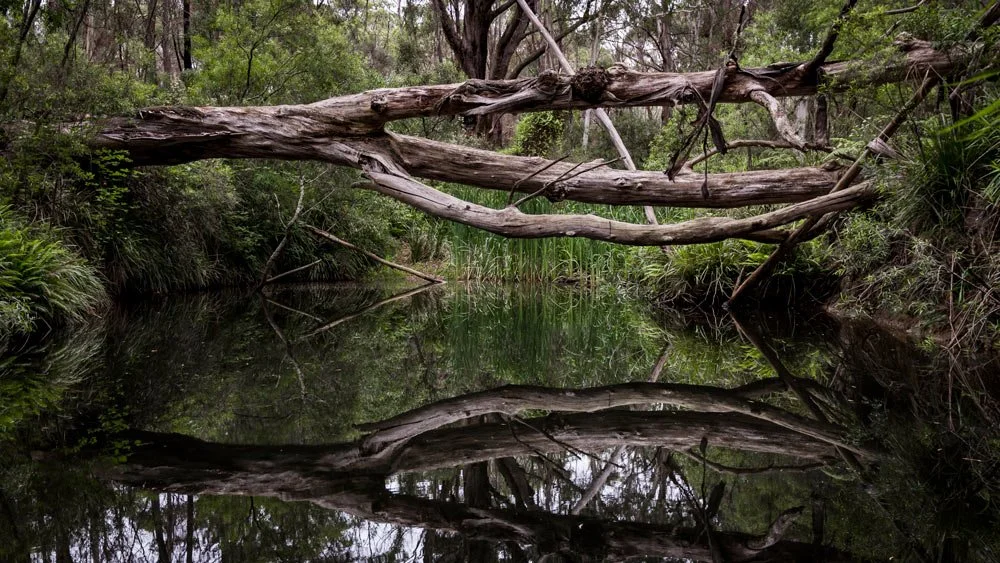
There’s a water hole, down by the creek, a hiatus in a once-flowing river, hidden behind the dense bracken and wild blackberries, peeping through the razor-edged bandy wallop. It was once a swimming hole, a place for visitors to picnic and bathe, filled with fresh running water. Water that now flows upstream, not down, filling dams that supply the city with water, denying the land its natural use.
We like to go down to the waterhole on a hot summer’s day and jump in the murky water, careful not to let our feet touch the muddy bottom – frightened a yabby might nip our wiggling toes. The hole is not deep, but the still water is freezing, not the kind of water to frolic in.
Jump in. Get wet. Get out.
My brothers lug an old bathtub down to the water’s edge, thinking it might float like a boat. They launch it, jumping in just as it hits the water, sinking rapidly to the bottom, scrambling out, screaming and laughing.
‘You’ll get in trouble,’ we tell them, knowing Dad will have to pull it out by tractor.
‘Dad won’t find out,’ says my eldest brother, ‘not unless you tell him.’ This we fully intend to do. There will be a reckoning later. Right now it’s more fun to retrieve the tub lodged in the glutinous bottom and watch it sink all over again.
Some days we take a bucket, knotting a long rope made of twine to the handle and launch it from the water’s edge, scraping it along the muddy bottom, in the hope of catching a yabby. I’ve never seen one, and we’ve never caught one, but we know they are there. Dad told us. We are not brave enough to straddle the trunk of the fallen tree that lays across the full width of the waterhole. Its stump is riddled with ants and who knows what else.
There is a platypus too. Though none of us have ever seen that either. They’re shy flat-billed creatures, mammals with no teats, hiding underwater, waiting for us to leave. They can regulate their heart to 10 beats a minute. We know this because my mother has read it to us from an encyclopaedia which lives in the bookcase in the stair room, the room that leads up to our bedrooms. None of us has ever touched the gold embossed red-linen volumes lined up along the bottom shelf like soldiers. Only Mum.
You’d have to be here at dusk to catch a glimpse of the platypus, but the midges will eat you alive. You’d be lucky to see it and accused of lying if you did. Everything is hidden in this place – wombats, foxes, rabbits, snakes, trapdoor spiders, and the keys to dad’s gun cupboard.
Pulling ourselves out of the muddy water, gripping tufts of grass as we drag ourselves up the embankment, our scrawny bodies are slimed with a fine film of mud. We sun ourselves dry, put on our clothes and go looking for blackberries, feasting on them until our fingers and teeth are black. The Council keeps threatening to come and spray them, declaring them a noxious weed. Like everything, the poison will find its way into the river.
The water dragons return to drink, and the native scrub birds scatter when they hear the cawing of the crows. Cries that remind us that there is no rich black soil from which to pluck worms; no verdant seeded grassland depicted in the poetry we read at school, only sandstone and funnel webs, bottle brushes and radiata pines. Not even a sunburnt country, just dry and sandy soil. This is not grazing land. It’s not anything land; it’s just ours.
Parts of the land have been cleared. That’s what the government required. The removal of a landscape that didn’t look like the paintings in our schoolbooks; a landscape where the wildflowers resemble colourful spiders, and the trees shed their bark, their branches ghostly, holding spindly leaves. But this bush is ours. Ours to play in. We give it names, imperial in intent: the rocky part, the crossing, the waterhole, and the two-humped rock we call the camel. Our own secret map of its treasures.
Before we make our way back to the house, we cross the river and climb our way to the overhanging caves that hug the waterline, guarded by bracken and ferns. We beat a path to the top, our legs and arms whiplashed by unyielding scrub. We study the drawings of former inhabitants, scarred by graffiti. We hunt around for flints in the remnants of fireplaces, unsure of what we are looking for. Only that this was once a sacred place, a place where the blackfellas lived.
Dad won’t let the inquisitive men from the museum near the caves. Says they’ll trample on them, rub the drawings with their fingers. They are not bushmen. Their ironed shirts and polished boots belie their interest. They are not welcome here. It’s not the blackfellas’ dad’s protecting – they’ve long gone. It’s his property now. No-one can lay claim to it.
We head back to the house, hungry, mischief written all over our faces. My brother’s cart firewood from the wood heap, and collect kindling, ready to light the wood-fired stove – it gets cold here at night. My sisters and I prepare vegetables for dinner, set the table, waiting for mum and dad to return home from work. Mum, fatigued, her eyes like receding tides. Dad, weary, sun-bleached, looking for fault lines, fissures to fill with resentment and frustration. He scans the shadow board in his work shed, checking that things have not been moved. Everything has its place.
The house shudders. There’s a railway track that passes by the edge of the paddocks. The roar of the train engines late at night crack open the silence and reminds the nightlife that this can be a dangerous place. The sound of the wheels thudding on the tracks telling us it’s a goods train, seemingly going on forever, and not yet dawn. The wombats feel the track vibrations from miles away and are cautious, grunting at the incursion. Foxes complain, yowling as the field mice scatter away to safety. The kangaroos remain alert, down by the river; the koalas and wild boar long gone.
We rarely venture out at night. Its pitch back and impossible to see. Only the Milky Way lights up the night sky, enveloping our dreams and blanketing us with a reassurance that we are a tiny part of this great universe. And there are other places to go.